
KENET Travel Grantee Presents Paper at ICETT 2026 in South Korea
Ms. Salome Chemiat, a Teaching Fellow at Strathmore University, presented a paper titled “An Adaptive Game-Based Educational Tool for Maternal and Neonatal Health: A Proof-of-Concept Study” at the 2026 12th International Conference on Education and Training Technologies (ICETT 2026) held in Seoul, South Korea from May 22-24, 2026 following a Travel Grant issued by KENET.
The KENET Travel Grants support faculty and graduate students from member institutions to attend and present papers at international conferences, enabling them to gain exposure to global ideas and collaboration. The Grants also aim to enhance the visibility of research from the Kenyan education and research community.
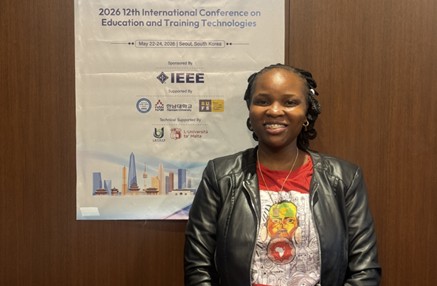
Ms. Salome Chemiat, Teaching Fellow, Strathmore University at the 12th International Conference on Education and Training Technologies (ICETT 2026) in Seoul, South Korea.
Ms. Chemiat described the experience as life-changing, both personally and professionally, and noted that it was a crucial milestone in her academic and career journey as she works towards attaining a doctorate.
“Being able to participate in an international conference, interact with researchers from different parts of the world, and successfully present my work gave me greater confidence in my abilities and strengthened my desire to continue growing in research and academia,” she stated.
“This experience exposed me to new ideas, diverse perspectives, and the importance of global collaboration in solving real-world challenges. It also allowed me to better understand the level of dedication, professionalism, and innovation required in the academic field. I now feel more motivated and inspired to continue improving myself so that I can become a stronger and more valuable PhD candidate in the future.”
She appreciated KENET for the support, noting that it made her realize there exists systems and institutions willing to invest in emerging scholars and researchers and help them grow both academically and professionally.
“Beyond the academic experience, this journey also gave me personal encouragement and hope. It showed me that opportunities can exist beyond what we sometimes imagine for ourselves, and with support, hard work, and determination, growth is possible,” she noted.
Her study explored how artificial intelligence and gamification can be used to improve health outcomes by delivering maternal and newborn information in an interactive, engaging, and easy-to-understand format. The research sought to address the persistent challenge of high maternal and neonatal mortality rates in Kenya, particularly in low- and middle-income settings, where gaps in accessible and effective health education continue to contribute to preventable deaths.
The prototype tool developed uses adaptive learning techniques, game-based scenarios, quizzes, rewards, and AI-powered support to help users better understand key issues related to pregnancy, childbirth, and newborn care. According to the findings, this technology-driven approach has the potential to enhance health knowledge, encourage positive health-seeking behaviours, and make maternal health education more accessible to a wider population.