
From Microscope to Machine Intelligence: AI's Role in Urine Analysis
For a long time, microscopic urinalysis has been one of the most widely used laboratory tests for diagnosing and monitoring a wide range of diseases. Laboratory technicians examine urine sediments under a microscope to detect abnormalities associated with conditions such as urinary tract infections, kidney disease, and diabetes-related complications. Despite its clinical value, the process remains largely manual, making it time-consuming, prone to variations in interpretation and susceptible to missing subtle abnormalities that could delay diagnosis.
To address these challenges, Dr. John Wandeto, a Senior Lecturer in the School of Computer Science and IT at Dedan Kimathi University of Technology (DeKUT), is leading an innovative research project titled Microscopic Urinalysis Test Using a Convolutional Neural Network Model for Early Disease Detections and Monitoring.
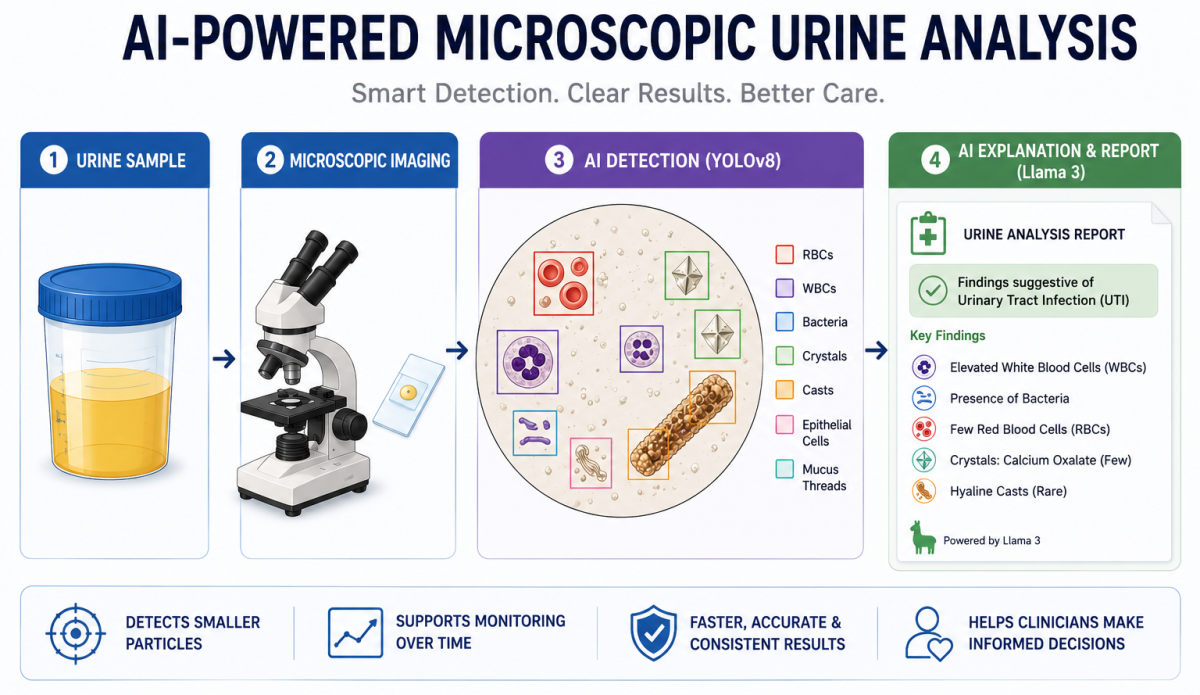
An illustration of AI-powered Microscopic Urinalysis.
Dr. Wandeto was awarded a Ksh. 1.5 million Research Grant in the FY 2023/2024 under KENET’s Computer Science and Information Systems (CSIS) Special Interest Group (SIG) academic area to undertake the research project in collaboration with Karatina University and Nyeri County Referral Hospital.
The grant supported the acquisition of a digital microscope fitted with a camera for capturing microscopic urine images, as well as a high-performance computer for training the artificial intelligence (AI) model that powers the diagnostic system.
"The research grant from KENET was a big win. We could not have imagined undertaking this research without the camera that the grant enabled us to buy. For many of our clinical partners, integrating such a camera with a conventional microscope was a completely new concept. I would say the grant was actually the foundation of the project," noted Dr. Wandeto.
Beyond financial support, the project’s website is hosted on KENET servers, providing a reliable platform for sharing research findings, project updates and information with collaborators and the wider public.
At the heart of the research is a Convolutional Neural Network (CNN), a form of deep learning that has revolutionized computer vision by enabling computers to recognize and interpret images with remarkable accuracy.
First, microscopic images of urine sediment are captured using digital imaging equipment and compiled into a dataset. These images are then carefully reviewed and annotated by laboratory experts, who identify and label the various particles present. The labelled images serve as training data that enables the AI model to learn the distinguishing characteristics of different urine components and abnormalities.
Through repeated exposure to thousands of examples, the model gradually develops the ability to classify microscopic particles and detect patterns associated with disease. The AI system can analyze newly-captured microscopic urine images within seconds, identify abnormalities that may indicate disease and present results that support laboratory professionals in making informed diagnostic decisions.
Rather than replace laboratory personnel, the technology is designed to serve as an intelligent decision-support tool, reducing repetitive manual work while improving consistency and minimizing the possibility of oversight. This is particularly valuable in busy laboratories where large volumes of samples are processed daily.
"This research uses computer vision to capture microscopic images of urine samples, which are then used to train an AI model to identify abnormalities much like a laboratory technologist would. The difference is that the AI can interpret these images with remarkable speed and consistency, and in some cases detect tiny particles that may be difficult for the human eye to see," remarked Dr. Wandeto.
Other than diagnosis, the technology is also purposed to improve long-term patient monitoring. It can detect even subtle changes in urine samples over time, helping clinicians determine whether a patient's condition is improving, remaining stable or deteriorating. This enables more effective monitoring of treatment progress, timely adjustments to care, and more informed, personalised treatment decisions.