
KENET Concludes its Regional Cybersecurity Training Series in Nairobi and Nakuru
KENET successfully concluded its Regional Cybersecurity Training Series with two additional workshops held in Nairobi and Nakuru, extending the original plan of five regional sessions to seven. The expansion was driven by strong demand and the need to reach more ICT professionals across member institutions. The sixth workshop took place at Hyatt Regency, Westlands, Nairobi, from July 27–31, 2026, drawing 73 participants. The seventh and final workshop, hosted at Sarova Woodlands Hotel and Spa, Nakuru, from August 24–28, 2026, recorded the highest attendance in the series with 118 participants. Together, these sessions brought System Administrators, Network Administrators, and ICT Support Staff into hands-on training environments designed to strengthen institutional cybersecurity resilience.
The workshops were part of the two-year ICANN-funded program, “Strengthening Kenya’s Cybersecurity Posture: Inclusive Capacity Building across Five Regions.” The trainings were delivered through two tracks: securing institutional e-mail, websites and identity systems, and securing campus networks and IT assets.
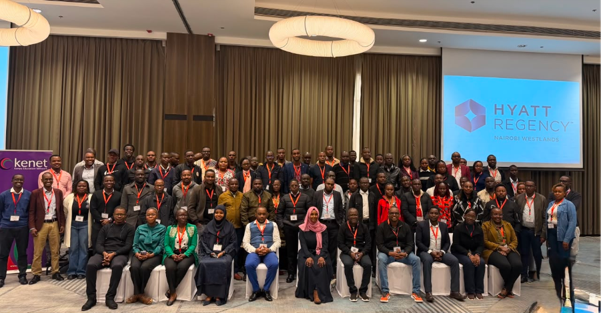
Group photo on the last day of the cybersecurity workshop held at Hyatt Regency, Nairobi.
Participants highlighted the hands-on nature of the training and the practical skills gained during the sessions. Arnold Mutua, a Network and Systems Administrator at the Machakos Technical Institute for the Blind, said the Nairobi workshop gave him an opportunity to strengthen his cybersecurity skills, learn how to secure ICT assets and networks, and interact with experts and fellow ICT professionals.
“The hands-on virtual lab sessions allowed us to train using an actual simulated environment. I was able to configure and troubleshoot routers and servers, configure switches and computers, and get an introduction to Linux environments. Being able to practise these configurations and tests virtually gave me practical experience without the risk of disrupting live systems,” he said.
Similarly, Brenda Nyangweso, an ICT Administrator at Adventist University of Africa, described the training as valuable and eye-opening, highlighting the practical skills she gained in securing email systems, identity and authentication, web applications and Wi-Fi networks. She said she looked forward to applying the lessons at her university, particularly by implementing Identity and Access Management and eduroam.

Trainees and trainers during the cybersecurity workshop at Sarova Woodlands Hotel and Spa in Nakuru
At the Nakuru workshop, Prof. Lossan Bonde, an Associate Professor of Computer Science at Adventist University of Africa, said the five-day training provided a platform for ICT professionals from different institutions to enhance their knowledge and skills, share experiences and build professional networks.
He highlighted the hands-on sessions as one of the most valuable aspects of the programme, noting that they enabled participants to move beyond theoretical knowledge and apply their skills to real-world security challenges.
“As I go back to my university, I am going to work with my colleagues to implement what I have learned, strengthen our systems, and provide a better environment and experience for our students and researchers,” Prof. Bonde said.
On her part, Everline Wambi, an ICT Officer at the Higher Education Loans Board, said the Nakuru training equipped her with practical knowledge in areas including the DNS lifecycle and security, email authentication protocols such as SPF, DKIM and DMARC, and identity management. The training also included practical sessions on LDAP, RADIUS, eduroam and web security.
“I want to be a cybersecurity ambassador in my institution, share what I have learned with my colleagues, and help ensure that good cybersecurity practices are understood and implemented,” Ms. Wambi said.
The seven in-person workshops have benefited more than 500 trainees, with a further 1,000 participants targeted through virtual trainings during the financial year. The workshops were aimed at developing a pool of skilled ICT professionals capable of championing cybersecurity best practices within their institutions, thereby enhancing cyber resilience across the country through a multiplier effect.